
Ashburton | Bovey Tracey | Brixham | Buckfastleigh | Dawlish | Exeter | Teignmouth | Totnes | Torquay | Paignton | Newton Abbot
07950 609768
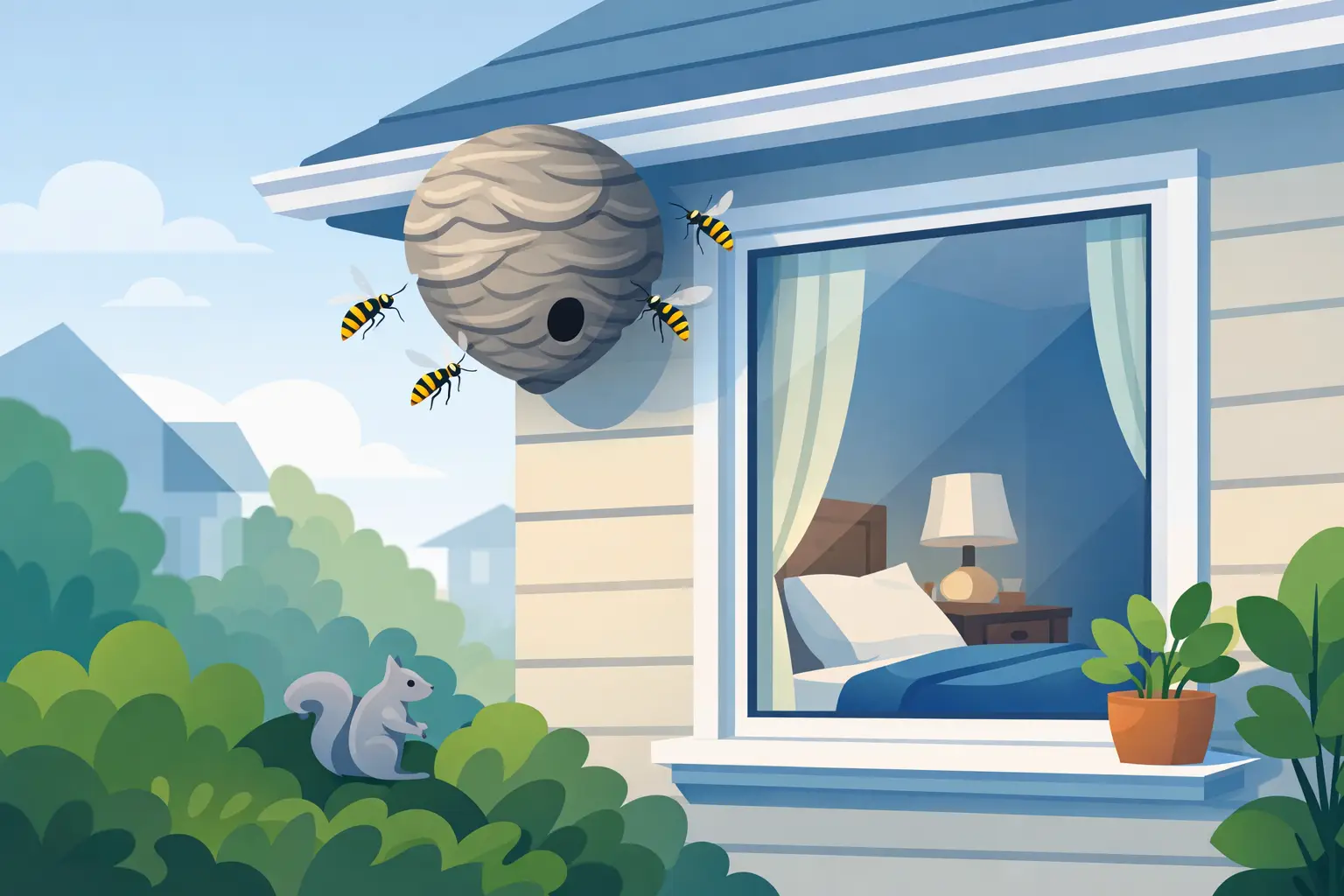
If you have spotted a wasp nest near bedroom window, it tends to feel a lot more urgent than a nest elsewhere on the property. The problem is not just the nest itself. It is the constant movement at eye level, the buzzing early in the morning, and the worry that opening a window could bring wasps straight into the room.
In most cases, the safest response is simple – keep your distance, keep the window shut, and avoid trying to deal with it yourself. A nest near a bedroom creates a higher chance of disturbance, and disturbed wasps can become aggressive very quickly.
A nest tucked under eaves, inside a wall cavity, behind cladding or close to a window frame causes problems because people naturally use that area every day. Windows are opened for air, curtains are moved, lights are switched on at night, and bedrooms are occupied when people are tired and less alert. That regular activity can unsettle wasps, even if you are not directly touching the nest.
There is also the simple fact of proximity. Wasps use a clear flight path in and out of the nest. If that route crosses your window, they may gather around the glass, investigate openings, or end up inside by mistake. One or two wasps in a room is stressful enough. A nest just outside increases the odds of repeat visits.
This matters even more in homes with children, older residents, or anyone who has a known reaction to stings. Even without an allergy, multiple stings are painful and can be dangerous.
Not every papery structure near a window is active, and not every cluster of wasps means the nest is visible. A working nest usually has steady traffic. You will see wasps coming and going from one point, often every few seconds during warmer parts of the day.
The nest itself may look grey or brown and papery, often round or slightly oval. Some are fully visible under soffits or in shrubs, while others are hidden in a cavity with only a small entrance hole showing. If wasps are repeatedly entering a gap in brickwork, fascia boards, vents or around the window frame, there may be a nest inside the structure rather than out in the open.
A quiet, old nest from a previous season is different. These are often dry, fragile and have no visible activity. Still, if you are unsure, treat it as active until it has been properly checked.
This is where many situations get worse. People often try the quickest fix they can think of, especially if the nest is keeping them awake or making them nervous about using the room.
Do not poke the nest, spray it with household aerosol, hit it with a broom, block the entrance, or try to knock it down. Those actions can trap wasps inside a cavity or provoke a defensive swarm. A nest near a bedroom window is too close to living space for guesswork.
It is also unwise to open the window and see what happens. Wasps drawn to light, warmth or air movement can come indoors fast, and then you are dealing with a nest outside and agitated wasps inside.
DIY treatment can occasionally work on small, exposed nests, but the trade-off is risk. If the nest is hidden in a wall, above a window, in roofline voids or difficult to reach safely, a home treatment often misses the heart of the problem.
The first priority is reducing disturbance. Keep the bedroom window closed until the nest has been dealt with. If the room becomes stuffy, open windows elsewhere in the house where possible and use ventilation that does not affect the nest area.
Keep curtains and blinds as still as you can, especially if they sit close to the outside entrance point. At night, avoid leaving that room brightly lit with the window open, as wasps already active around the frame may be drawn to movement and light.
If a wasp gets into the bedroom, stay calm. Shut the internal door, open one other exit route if it is safe to do so, and let it find its way out. Swatting usually makes matters worse.
If anyone in the property has a history of severe allergic reaction to stings, take the situation seriously from the start. A nest near a sleeping area is not something to leave and monitor for long.
Sometimes, yes. A nest at the far end of a garden or high on an outbuilding with little human activity around it may be left if it poses no real risk. The position is what matters.
A wasp nest near bedroom window is a different situation. Because the nest is close to a regularly used part of the house, the chance of accidental disturbance is much higher. Even if the wasps seem calm today, activity usually builds through the season as the colony grows.
That is why waiting can be a false economy. A small nest in early summer is generally easier to deal with than a larger, busier one later on. There is no benefit in letting it become a bigger issue if the location is already causing concern.
If the nest is attached to the building, hidden in a cavity, close to a child’s bedroom, or causing wasps to enter the house, it is sensible to get professional help. The same applies if you cannot clearly see the nest but can see a steady stream of wasps using a gap near the window.
Professional treatment is about more than spraying an area and hoping for the best. The job is to identify the nest position, assess how wasps are accessing it, apply the correct treatment safely, and advise on what happens next. In some cases, more than one nest may be present, particularly on larger properties or sites with sheds, garages and roof voids.
For householders across South Devon and the wider South West, a local specialist such as Elimipest South West will understand the kinds of nesting spots commonly found in older homes, newer developments, farm buildings and coastal properties. That practical local knowledge matters when nests are tucked into awkward rooflines or wall spaces.
A proper wasp treatment does not always mean instant silence the second it is applied. Activity may continue for a short period as returning wasps come back to the nest. That is normal.
What you should usually see is a clear drop-off in activity over the following hours and into the next day or so, depending on nest size and position. During that time, keep away from the area and continue to keep the bedroom window shut unless you have been told otherwise.
People often ask whether the nest itself needs to be removed. It depends on where it is. An exposed nest may sometimes be removed once inactive, but a nest in a cavity is often left in place if it no longer poses a problem. The key point is making it inactive safely.
You cannot make a property completely wasp-proof, but you can reduce the odds of repeat nesting around windows and rooflines. Small gaps around soffits, fascia boards, vents and cladding are common access points. Sealing suitable openings outside of the active nesting season can help.
It also makes sense to keep an eye on quiet corners in spring and early summer. A small amount of wasp activity around eaves or a window frame can be the first sign of a new nest being established. Catching that early is better than discovering a large nest once the room is already out of bounds.
Good maintenance helps, but there is always an element of chance. Some properties, particularly those with sheltered roof spaces, outbuildings or mature gardens, are simply more attractive to nesting wasps than others.
If you have found a wasp nest near bedroom window, treat it as a safety issue rather than a nuisance to put off until later. The closer a nest is to daily living space, the less room there is for trial and error. A calm, practical response now usually prevents a far bigger problem in the weeks ahead.


