
Ashburton | Bovey Tracey | Brixham | Buckfastleigh | Dawlish | Exeter | Teignmouth | Totnes | Torquay | Paignton | Newton Abbot
07950 609768
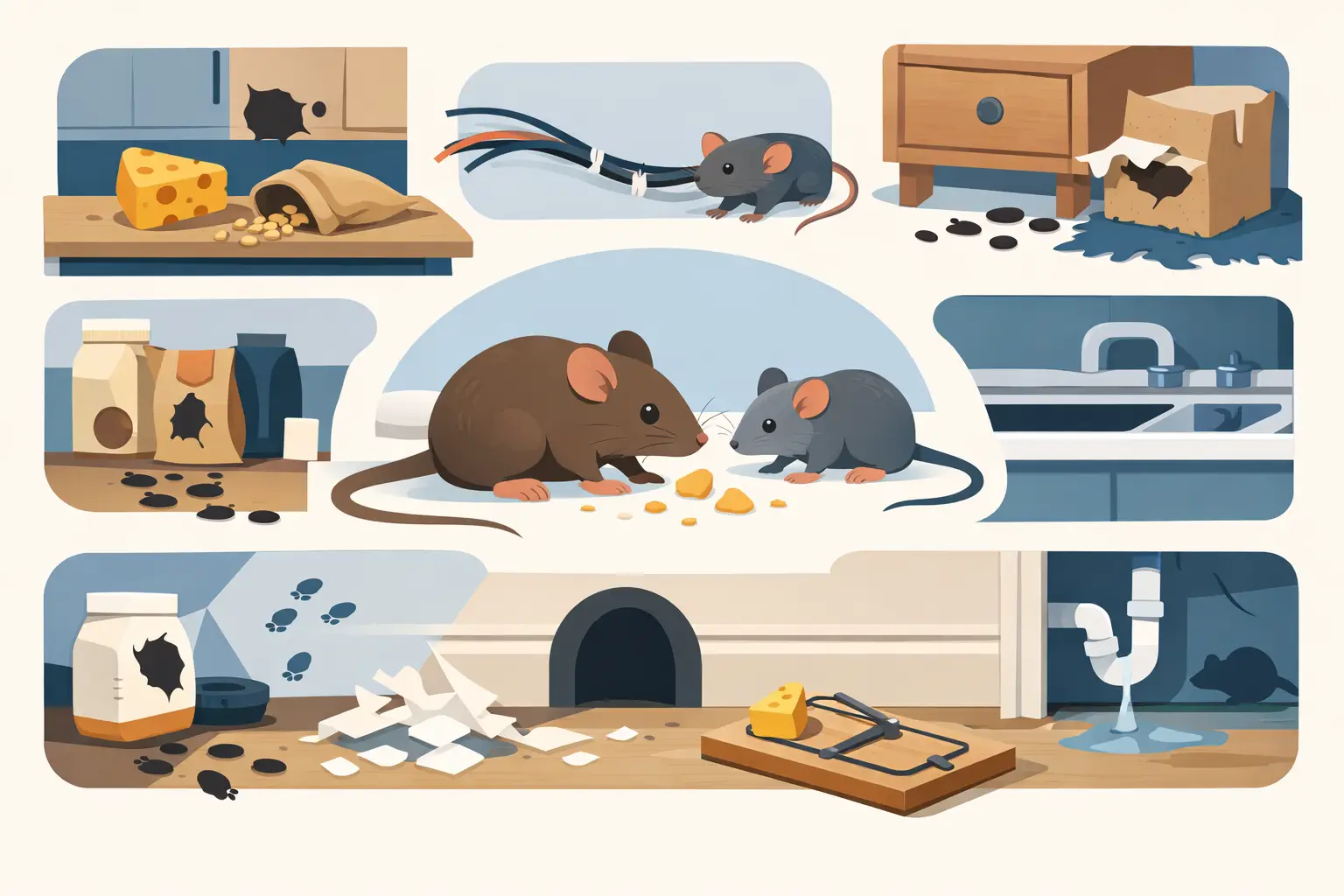
You usually notice mice after they have already settled in. A few droppings behind the toaster, a faint scratching in the wall at night, a chewed food packet in the pantry – these are often the first signs of mice infestation, and they rarely improve on their own. In homes, farms and business premises across the South West, mice are quick to exploit warmth, shelter and an easy food source.
Mice are small, quiet and good at staying out of sight, which is why early warning signs matter. Catching activity early can help limit contamination, avoid damage to wiring and insulation, and stop a minor issue turning into a well-established infestation.
The clearest sign is droppings. Mouse droppings are small, dark and shaped a bit like grains of rice, usually found along skirting boards, inside cupboards, under sinks, behind appliances or near stored food. Fresh droppings look darker and softer. Older droppings become dry and crumbly. If you keep finding new droppings after cleaning, that points to active movement rather than an old problem.
You may also notice gnaw marks. Mice need to keep their teeth worn down, so they chew regularly on wood, plasterboard, plastic packaging and sometimes electrical cabling. In kitchens and utility rooms, this often shows up on food containers, cupboard corners or pipe boxing. In lofts, garages and outbuildings, the damage can be less obvious until it becomes more serious.
Scratching sounds are another common clue. Mice are most active at night, so people often hear movement in wall cavities, ceilings, under floorboards or behind kitchen units once the house goes quiet. The sound is usually light, quick and irregular rather than heavy thumping. If the noise is mainly after dark and in the same area, mice are a strong possibility.
A stale, musky smell can develop where mice are active for some time. This tends to build in enclosed spaces such as cupboards, loft voids, storage rooms and under units. The smell alone is not proof, but alongside droppings or gnawing it becomes a strong indicator.
Different parts of a property show different patterns of activity. In kitchens, the signs are usually linked to food and warmth. You might see torn packets, droppings at the back of cupboards, greasy smear marks along walls, or nesting material tucked behind appliances. Mice often travel the same routes repeatedly, especially where they can stay close to edges and hidden gaps.
In lofts, activity can be harder to spot at first. Homeowners often hear scratching before they see any evidence. Nesting material is common here – shredded insulation, paper, fabric or dried plant matter gathered into a hidden space. If a loft has stored boxes, old soft furnishings or undisturbed corners, it offers exactly the sort of shelter mice like.
Sheds, garages and outbuildings are also regular problem areas, particularly in autumn and winter. Seed, pet food, bird feed and general clutter all make these spaces more attractive. On farms and rural properties, feed stores and machinery sheds are obvious risk points. A small amount of activity in an outbuilding can easily spread into the main property if entry points are available.
Not every infestation starts with something dramatic. Smear marks are one example. As mice move along the same paths, the oils and dirt in their fur can leave dark rub marks on skirting boards, pipes or wall edges. These are easy to overlook unless you know what you are looking for.
Tracks can also appear in dusty areas. In lofts, under cupboards or in sheds, mice may leave tiny footprints or tail marks through settled dust. If you suspect activity in one of these places, small signs like this can confirm regular movement.
Pets sometimes pick up on mice before people do. Dogs may become fixed on a cupboard, appliance or section of wall, while cats often spend long periods watching a particular area. That said, pets are not a diagnosis on their own. They can react to all sorts of sounds and scents, so it still helps to look for physical evidence.
You might also notice nesting material appearing where it should not be. Shredded paper, loft insulation, cardboard, fabric and dried vegetation can all be used. Mice tend to build nests close to food and water but tucked well out of sight, so finding loose nesting material in one place can mean the nest itself is nearby.
Mice are not just an annoyance. They contaminate surfaces and food stores with droppings and urine, and they can carry bacteria through preparation areas, stock rooms and storage spaces. In commercial settings this can quickly become a hygiene and compliance issue. In homes, it is often the kitchen, pantry or pet food area that is affected first.
There is also the issue of damage. Chewed wiring is a real concern, particularly in lofts, behind appliances and inside wall spaces where the problem can go unnoticed. Insulation, plasterboard, pipe lagging and stored goods can all be affected. On agricultural premises, feed contamination and repeated access to buildings can cause wider ongoing problems if the source is not dealt with properly.
The other reason to act early is simple – mice breed quickly. A small amount of activity can become a much larger problem in a short space of time if conditions suit them. Waiting to see if it settles down rarely works.
Start with the obvious hotspots. Look under sinks, behind cookers and washing machines, inside pantry cupboards, around boiler cupboards, in loft spaces and near any stored food. Check for gaps around pipes, damaged air bricks, poorly fitted doors and broken vents. Mice can get through surprisingly small openings, so what looks insignificant can still be enough.
It also helps to think about why they are there. Accessible food, cluttered storage, overflowing bins, pet food left out overnight and overgrown areas close to the building can all increase the risk. In rural settings, neighbouring fields, livestock areas and feed stores may play a part, so the answer is not always confined to one room or one building.
Cleaning up visible signs is sensible, but it does not solve the cause. If entry points remain open and food or shelter is still available, activity often continues behind the scenes.
A single sighting does not always mean a heavy infestation, but repeated signs usually mean there is an established issue somewhere in the property. If you are finding fresh droppings every day, hearing movement at night, or seeing damage in more than one area, the problem is already beyond guesswork.
This is especially true in businesses, rented properties, farms and food-related environments, where a quick and properly managed response matters. Treatment needs to be safe, effective and suited to the setting. In some cases that means controlling the active infestation first. In others, proofing and prevention are just as important as treatment itself.
An experienced local pest controller will not just look at where the mice are appearing. They will look at how they are getting in, what is sustaining the activity, and what practical steps will stop the issue returning. That is often the difference between a short-term reduction and a proper solution. For customers across Devon and the wider South West, Elimipest South West takes that no-fuss, tailored approach seriously.
Once mice have been dealt with, prevention becomes the next job. Good housekeeping helps, but it is only part of the picture. Food should be stored securely, clutter kept down, and likely harbourage reduced where possible. Entry points around pipes, doors, vents and rooflines need proper attention, especially in older properties and mixed-use rural buildings.
It also pays to stay alert to repeat signs. One or two droppings in a shed or feed room may not seem urgent, but small clues are often how bigger infestations begin. The earlier you spot them, the easier and cleaner the job tends to be.
If something feels off in your property, trust that instinct and check it properly. With mice, the signs are often there before the animal is ever seen, and acting on those early clues can save a lot of disruption later.


